Does Stress Cause IBS Flare-Ups? What to Track Before Blaming Food


If you live with IBS, you’ve probably asked yourself this question at least once: was it something I ate, or was it stress?
It’s an understandable question. Symptoms often seem to appear after a particular meal, making food feel like the obvious culprit. But many people also notice their IBS worsens during busy periods at work, family difficulties, travel, poor sleep, or other stressful events.
The challenge is that these factors often happen together. A stressful week might lead to different eating habits, less sleep, fewer opportunities to exercise, and more digestive symptoms. When everything overlaps, it can be difficult to know what actually contributed to the flare.
The good news is that modern IBS research gives us a clearer understanding of what’s happening.
The short answer
Yes, stress can contribute to IBS flare-ups.
But that doesn’t mean stress is the sole cause of your symptoms, and it doesn’t mean symptoms are “all in your head.”
IBS is now classified as a disorder of gut-brain interaction (Rome Foundation). This means the communication between the digestive system and the nervous system plays a central role in how symptoms develop and fluctuate.
For some people, food may be the biggest factor. For others, stress, sleep, hormonal changes, illness, or a combination of several triggers may be involved.
The important point is that IBS symptoms rarely exist in isolation. Looking at food alone may not give you the full picture.
What “disorder of gut-brain interaction” actually means
The term “disorder of gut-brain interaction” (DGBI) is now the clinical classification used by the American College of Gastroenterology (ACG) and the Rome Foundation for IBS.
While the name sounds technical, the concept is straightforward. Your gut and brain are constantly communicating through a network of nerves, hormones, immune signals, and chemical messengers. This communication happens whether you’re aware of it or not.
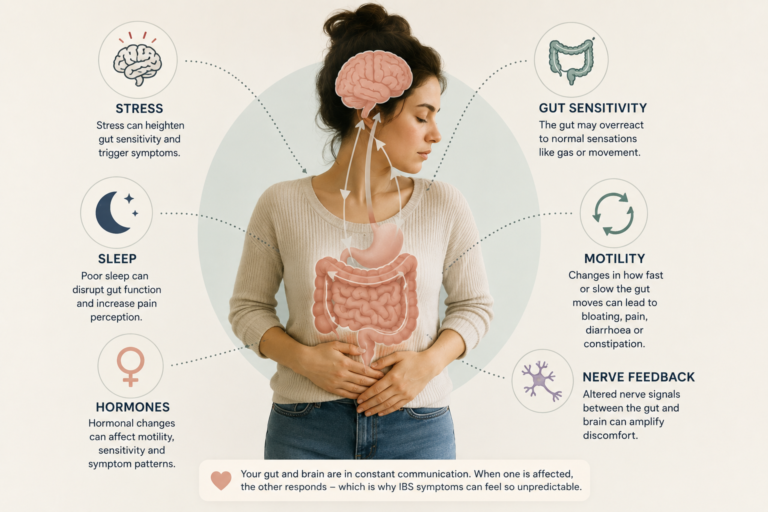
In people with IBS, this communication appears to function differently. The gut may become more sensitive to normal digestive processes. Signals travelling between the gut and brain may be amplified. Changes in stress levels, sleep, emotions, illness, or diet can all influence how symptoms are experienced.
This classification matters because it moves IBS beyond outdated ideas that symptoms are either purely physical or purely psychological. Instead, IBS is recognised as a condition involving both digestive and nervous system processes interacting together.
How stress changes the gut
Stress affects much more than mood. When the body perceives stress, it activates a series of physiological responses designed to help us respond to challenges. While useful in the short term, these responses can also influence digestion.
Several mechanisms may contribute to IBS symptoms.
Increased gut sensitivity
Many people with IBS experience what’s known as visceral hypersensitivity. In simple terms, sensations that might go unnoticed by someone else can feel uncomfortable or painful in someone with IBS. Stress can increase this sensitivity, making normal digestive activity feel more noticeable.
Changes in gut motility
Motility refers to the movement of food through the digestive tract. Stress can speed up or slow down these movements depending on the individual. For some people this may contribute to diarrhoea, while for others it may worsen constipation.
Changes in gut-brain signalling
The gut and brain communicate continuously through what is often called the gut-brain axis. Periods of stress can alter this communication, affecting symptom severity, bowel habits, and how strongly digestive sensations are perceived.
The role of sleep
Stress and sleep often influence each other. Poor sleep has been associated with worsening IBS symptoms, while IBS symptoms themselves can disrupt sleep quality. This can create a cycle where symptoms and stress reinforce one another (Lee and Lee, 2017).

Why stress can look like a food trigger when it isn’t
This is where things often become confusing. Imagine you’ve had a demanding week at work. You’ve slept poorly, skipped lunch a few times, relied on convenience foods, and felt under pressure most days. By Friday evening, your IBS symptoms flare.
It’s natural to focus on the meal you ate before symptoms appeared. But was it the meal itself? Possibly. Was it the stress? Possibly. Was it the combination of stress, disrupted sleep, altered eating patterns, and the meal? That may be even more likely.
Research suggests stress can affect how foods are tolerated. A meal that causes no issues during a relaxed holiday might produce symptoms during a particularly stressful period. This doesn’t mean the food is irrelevant. It means the context matters too.
Without tracking both lifestyle factors and food intake, it’s easy to blame the wrong trigger. This can sometimes lead people to remove more and more foods from their diet without actually addressing the broader pattern driving symptoms.
What to track if you suspect stress is part of your pattern
If you’re trying to understand what influences your IBS symptoms, tracking more than food can be helpful. You don’t need an overly complicated system. The goal is simply to gather enough information to spot patterns that may not be obvious day to day.
Food and drinks
Record what you eat and drink as accurately as possible. You don’t need to obsess over every gram, but noting meals, snacks, and significant ingredients can provide useful context.
Symptoms
Track digestive symptoms such as:
- Abdominal pain
- Bloating
- Diarrhoea
- Constipation
- Urgency
- Excess gas
Recording symptom timing is often just as important as recording the symptoms themselves.
Stress levels
Consider using a simple daily rating scale from 1 to 5 or 1 to 10. The goal isn’t to measure stress perfectly. It’s simply to capture whether a day felt relatively calm or unusually stressful.
Sleep
Record:
- Approximate hours slept
- Sleep quality
- Night-time waking
Sleep often turns out to be an overlooked part of the puzzle.
Significant life events
Deadlines, travel, illness, relationship difficulties, major social events, and changes in routine can all be useful context when reviewing symptom patterns.
Timing
Patterns often emerge when you look at timing rather than individual events. For example, symptoms may consistently appear the day after poor sleep rather than immediately after a particular food. Or you might notice symptoms tend to occur when higher stress and certain foods appear together. These are the kinds of patterns that are difficult to identify from memory alone.
What the evidence says actually helps
Because IBS involves gut-brain interactions, researchers have explored treatments that address both digestive symptoms and the way the brain and gut communicate.
The 2021 American College of Gastroenterology guideline conditionally suggests gut-directed psychotherapy for global IBS symptoms, while noting that the supporting evidence is of very low quality. This does not mean IBS is a psychological condition. Rather, it reflects the fact that modifying gut-brain communication can improve symptoms for some people.
Examples include:
Cognitive behavioural therapy (CBT)
CBT aims to identify and modify thought patterns and behaviours that may contribute to symptom-related distress and symptom cycles (Keefer et al., 2022).
Gut-directed hypnotherapy
This is a structured therapeutic approach designed specifically for digestive conditions. Clinical studies suggest it may improve symptoms for some people with IBS.
Stress-management approaches
While evidence varies between different techniques, many people find that reducing overall stress levels supports broader symptom management. If stress appears to play a significant role in your symptoms, discussing options with a GP, gastroenterologist, or qualified mental health professional may be worthwhile. These approaches are not a substitute for medical evaluation and may not be appropriate for everyone.
The honest closing
Stress matters in IBS. Food matters too. So do sleep, hormones, illness, routine changes, and a range of other factors that can influence the gut-brain connection.
The challenge is that these factors often interact, making it difficult to know which one deserves the blame when symptoms flare. That’s why tracking only food can sometimes be misleading.
When you record stress, sleep, symptoms, timing, and food together, patterns often become easier to see. Not perfect answers, but useful clues that can help guide conversations with your healthcare team.
If symptoms are severe, changing, persistent, or affecting your quality of life, speak with a qualified healthcare professional rather than relying on self-diagnosis.
If you’d like a food and symptom diary built for this kind of tracking, mySymptoms offers a free trial and lets you log food, symptoms, timing, stress and sleep in one place, and analyse individual logged factors one at a time to highlight patterns and possible links with symptoms. It won’t diagnose IBS or tell you what to cut from your diet, but it can give you and your clinician something concrete to work from.
Frequently asked questions
Can stress alone cause IBS symptoms?
Stress can contribute to IBS symptoms and symptom severity, but it is unlikely to be the only factor for most people. Food, sleep, hormones, illness, and other influences often interact with stress.
Can anxiety make IBS worse?
Many people report worse IBS symptoms during periods of increased anxiety. Research supports a connection between anxiety, gut-brain communication, and digestive symptoms in IBS.
Why do certain foods bother me only sometimes?
Tolerance can vary depending on factors such as stress levels, sleep quality, portion size, illness, and overall digestive sensitivity at the time.
Should I focus on stress or food first?
Most people benefit from tracking both. Looking at one factor in isolation may cause you to miss important patterns.
Does reducing stress cure IBS?
No. While stress reduction may help some people experience fewer or less severe symptoms, IBS is a complex condition and there is currently no single cure.
When should I see a doctor about IBS symptoms?
Speak with a healthcare professional if symptoms are new, worsening, persistent, severe, affecting your quality of life, or accompanied by symptoms such as unexplained weight loss, rectal bleeding, or anaemia.
Sources
- American College of Gastroenterology (n.d.) Irritable Bowel Syndrome (IBS). Available at: https://gi.org/topics/irritable-bowel-syndrome/
- Lacy, B.E., Pimentel, M., Brenner, D.M., Chey, W.D., Keefer, L.A., Long, M.D., Moshiree, B., Chang, L. and Lembo, A.J. (2021) ’ACG Clinical Guideline: Management of Irritable Bowel Syndrome’, The American Journal of Gastroenterology.
- Rome Foundation. Rome V and Disorders of Gut-Brain Interaction. Available at: https://theromefoundation.org/rome-iv/rome-v/
- Keefer, L., Palsson, O.S., Pandolfino, J.E. and the Rome Foundation Working Team (2022) ’Best practice recommendations for behavioural and integrative treatments for disorders of gut-brain interaction’, Gastroenterology, doi:10.1053/j.gastro.2022.01.024.
- Lee, Y.J. and Lee, J.H. (2017) ’Sleep disturbances in irritable bowel syndrome: a systematic review’, Journal of Gastroenterology and Hepatology. Available at: https://pubmed.ncbi.nlm.nih.gov/27683238/
Important
mySymptoms is a food, symptom and lifestyle diary. It helps you record and review your own data — it does not diagnose, treat, cure or prevent any medical condition, and it is not a medical device. This article provides general information, not medical advice. Talk to a qualified healthcare professional about your individual symptoms, before changing your diet, or if your symptoms are severe or persistent.