
The 5 Most Common IBS Triggers — And Why “Common” Isn’t Yours


Every IBS article seems to start the same way: avoid these foods.
So you do. You drop gluten. You ditch dairy. You strip your diet down to “safe” lists until your meals look painfully beige (if you know, you know).
And still, the flares keep coming.
At that point, it’s tempting to assume “my gut is just sensitive” and leave it there.
Except it’s unfortunately not that simple.
Because the problem isn’t your willpower or your imagination. It’s that you’ve been given generic rules for a deeply individual condition.
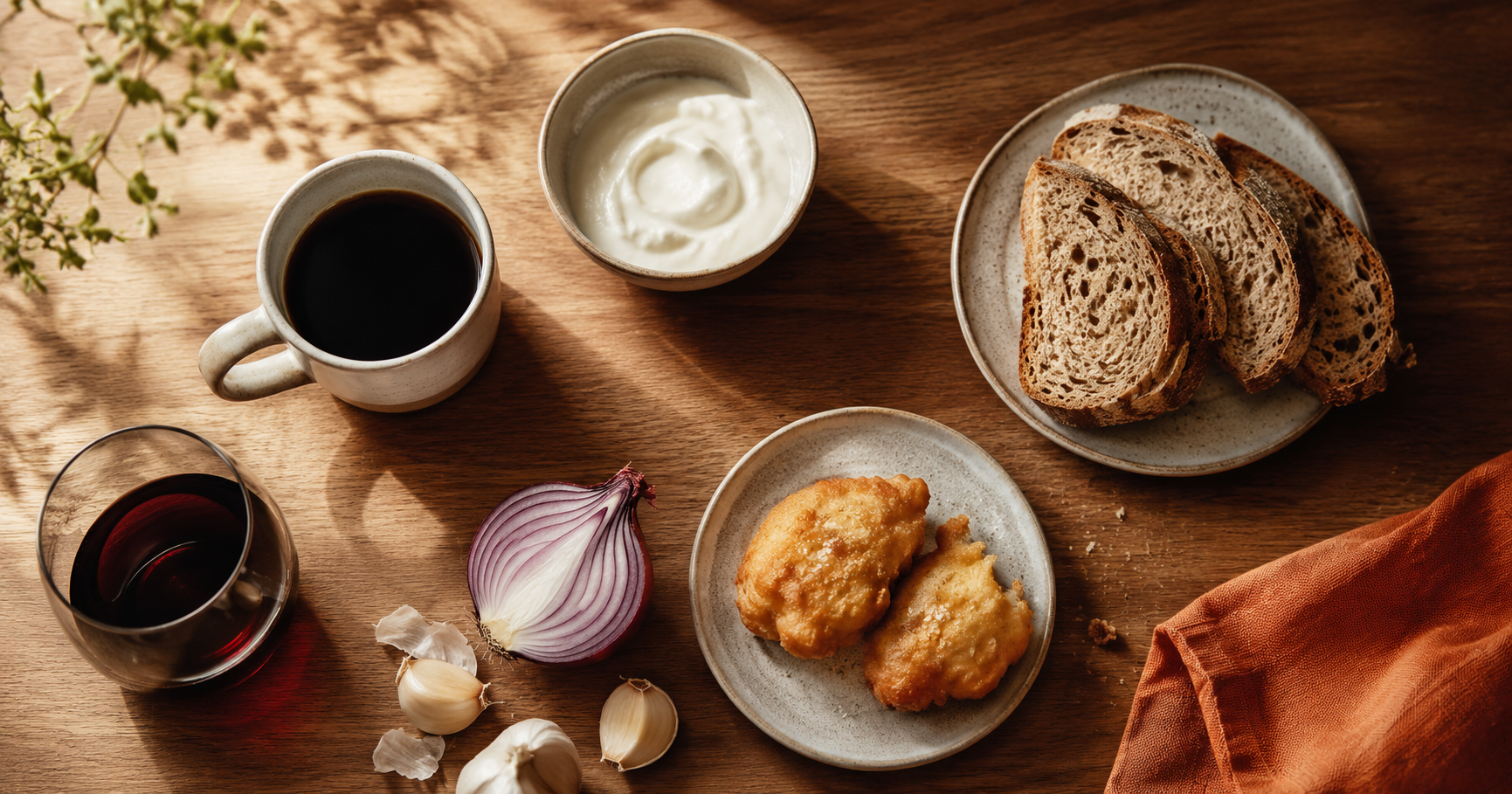
The 5 most common IBS triggers
Let’s start with the usual suspects. These foods turn up in research over and over, and for good reason. But remember: what’s common isn’t always yours.
1. FODMAPs (onion, garlic, wheat, legumes)
FODMAPs are short-chain carbohydrates that don’t absorb properly in the small intestine. They pull water into the gut, ferment fast and produce gas that stretches the intestinal wall. If your gut’s nerves are hypersensitive (which is common in IBS), that stretch feels like pain or urgency.
Here’s the twist: most people react to some FODMAP groups but not all. And it’s the dose that changes everything.
The 2021 ACG Clinical Guideline reports that between 50% and 75% of patients see meaningful improvement on a low-FODMAP diet. The other 25% to 50% don’t — so for a meaningful minority, eliminating all FODMAPs won’t fix much; it just makes eating and planning meals rather hard work.
2. Caffeine
Caffeine gets the gut moving. For IBS-C (constipation-predominant), that can be a gift; for IBS-D (diarrhoea-predominant), not so much. It can speed transit, increase urgency and send people running for the bathroom.
But the full story isn’t that neat. Many find caffeine only causes issues when stress or poor sleep are already pulling digestive strings. It’s not always the coffee. Sometimes it’s the stressful day or week you had before it.
3. Alcohol
Alcohol does a number on the gut. It can irritate the lining, increase permeability and shift the microbiome. Depending on the dose and type, it can either speed things up or slow them down.
Picture it: a night out, two glasses of wine, heavy meal, late bedtime. The next day might ensue gut chaos.
But it’s rarely just the alcohol. It’s the combination: sleep loss, fat, sugar, timing — all layering to push your gut over its limit.
4. Fatty or fried foods
High-fat meals are among the most commonly reported IBS triggers (Simrén et al., 2001), partly because fat slows gastric emptying while amplifying the colon’s contractile response — a mismatch that can cause cramping, bloating or sudden urgency after a heavy or fried meal.
The same dish made at home might sit just fine, which is a clue: it’s rarely the fat alone. Often it’s the portion size, cooking method or hidden extras (additives, for example) that push your gut past its comfort zone.
5. Dairy
Lactose needs the enzyme lactase to digest. Without enough lactase, lactose heads to the colon, where bacteria ferment it and cause gas and discomfort.
You’ll often notice it as: milk or yoghurt → a few hours later → bloating, pain or loose stools.
But here’s the important nuance: lactose intolerance isn’t IBS, and it’s dose-dependent. Many people tolerate cheese or small amounts of milk perfectly well. If you react inconsistently (fine one day, wrecked the next), lactose alone probably isn’t the real driver.

IBS isn’t about the food. It’s about the gut.
Here’s the light-bulb moment for most people: IBS is rarely about what you eat. It’s about how your gut handles what you eat.
That’s shaped by three factors that show up in every modern IBS guideline:
- Visceral sensitivity — how reactive your gut’s nerve endings are
- Motility — how fast or slow things move through
- The gut–brain axis — how stress or emotion rewires digestion in real time
The same meal can go down fine one day and start a riot the next, all because your nervous system was primed differently. The 2021 ACG guideline formally classifies IBS as a disorder of gut–brain interaction — a careful way of saying that the connection between what your mind is doing and what your gut is doing is real, measurable and central to the condition.
Why “common” doesn’t mean “yours”
Even if a food shows up on every IBS handout, your body’s reaction depends on context:
- Dose — a splash of milk in tea might be fine; a coffee, yoghurt and smoothie before noon might not.
- Cumulative effect — garlic bread alone isn’t always the problem; it’s garlic bread plus a rich pasta sauce plus a stressful day.
- Timing — some reactions can take 24–72 hours, so yesterday’s “safe” lunch might actually be today’s culprit.
And then there are the curveballs you won’t see on many lists: histamine-rich foods like tomatoes or aged cheese, sugar alcohols like sorbitol, or even certain fibres.
The false comfort of food lists
It’s an easy trap to fall into. You cut the obvious triggers. Things improve a little. Then everything stalls.
That plateau doesn’t have to be your new normal. It’s what happens when you follow general advice instead of your own data. Lists feel reassuring because they look like certainty. But IBS doesn’t care about lists. It cares about thresholds, timing and context.
How to actually spot your own patterns
The answer isn’t cutting more foods. It’s replacing guesses with patterns.
Start tracking food, symptoms, timing, sleep and stress. Over weeks, not days.
A diary like mySymptoms captures the raw data — food, symptoms, timing, stress, sleep, bowel habits — and the analysis highlights which individual foods most often appear alongside symptoms. The bigger patterns — cumulative effects, hidden combinations, the way stress or sleep changes how you respond — often need the wider review of the diary itself, which is where you (or you and a dietitian) read the bigger story.
And if symptoms are persistent or affecting your daily life, it’s worth working with a qualified clinician — a GP, dietitian or IBS specialist who can help you make sense of what you’re seeing.
The goal isn’t to micromanage every bite. It’s to get proof instead of relying on memory and mood.
Less flare. More freedom.
You might think tracking sounds like another chore. But this isn’t about more admin — it’s about gaining clarity.
When you start seeing your own patterns, food stops feeling like an enemy and becomes information. You’ll see when stress (not dinner) is the culprit. You’ll bring foods back in instead of deleting them forever.
Keep it simple, and stick with it long enough to see the shape of your gut’s story.
Because the next time you say “I think I know what’s triggering this,” it won’t be a guess — it’ll be a pattern you can see in your own data.
Want to start tracking?
If you’d like a diary built for this kind of tracking, mySymptoms is an app that lets you log food, symptoms, timing, stress, sleep and bowel habits in one place. The analysis highlights the food-symptom correlations it can see in your entries, and the rest of the diary gives you and your clinician the context to read the bigger patterns. It won’t diagnose IBS or tell you what to cut from your diet, but it can give you something concrete to bring to a GP or dietitian.
Sources
- Lacy BE et al. ACG Clinical Guideline: Management of Irritable Bowel Syndrome. American Journal of Gastroenterology, 2021. (American College of Gastroenterology) — IBS as disorder of gut–brain interaction; low-FODMAP diet 50–75% response figure; soluble fibre and dietary modification as first-line.
- Chey WD, Hashash JG, Manning L, Chang L. AGA Clinical Practice Update on the Role of Diet in Irritable Bowel Syndrome: Expert Review. Gastroenterology, 2022. — dietary intervention as evidence-based, FODMAP restriction phase 4–6 weeks max, reintroduction essential.
- Monash University FODMAP Program — FODMAP mechanism and food lists.
- Simrén M, Månsson A, Langkilde AM, et al. Food-related gastrointestinal symptoms in the irritable bowel syndrome. Digestion, 2001;63:108–115. — high-fat foods as commonly reported triggers.
- Mattar R, Luz GO, Oliveira RP. Management of lactose intolerance: treatment modalities and nutritional considerations. World Journal of Gastroenterology, 2012;18(33):4379–4386. — lactose intolerance dose-dependence.
- NICE Clinical Guideline CG61: Irritable bowel syndrome in adults — diagnosis and management. National Institute for Health and Care Excellence, 2008 (updated 2017). — UK first-line guidance, used as secondary reference.
Important
mySymptoms is a food, symptom and lifestyle diary. It helps you record and review your own data — it does not diagnose, treat, cure or prevent any medical condition, and it is not a medical device. This article is general information, not medical advice. Always consult a qualified healthcare professional about your symptoms or before changing your diet.