

Why Spotting Trigger Foods Without a Food Diary Is Just Guessing

Ask anyone with IBS how they found their “trigger foods,” and you’ll usually hear the same story: I noticed I felt bad after X, so I cut it out. Then a new flare happens. Another food gets blamed. The list grows, the meals shrink — and somehow you’re eating blander but feeling no better.
The truth is, most of us with IBS are playing dietary whack-a-mole. Without structured tracking, spotting triggers is guesswork dressed up as intuition.
Your memory is not a reliable witness
The gut rarely follows clean, cause-and-effect logic, but our brains desperately try to find patterns. Unfortunately, they’re terrible at it.
Memory for what we ate degrades quickly. Portion sizes go first, then sauces and toppings, then snacks — precisely the things that can tip your gut over the edge. Even when people are formally asked to recall what they ate the day before, dietary self-report studies consistently show meaningful under-reporting compared with objective biomarkers (Freedman et al., 2014).
Then there’s how our emotions skew perception. When you’re bloated or doubled over, your brain grabs the most obvious suspect (i.e. the last thing you ate) and builds a story around it. Cognitive scientists describe this as availability bias — the most easily remembered explanation feels like the most likely one, even when it isn’t. In IBS, that story often ends with the wrong food on trial.
Memory is emotional, not empirical. A bad salad sticks out more than the safe meal before it. Without records, your gut becomes the scapegoat for your brain’s poor detective work.
The myth of the one-meal culprit
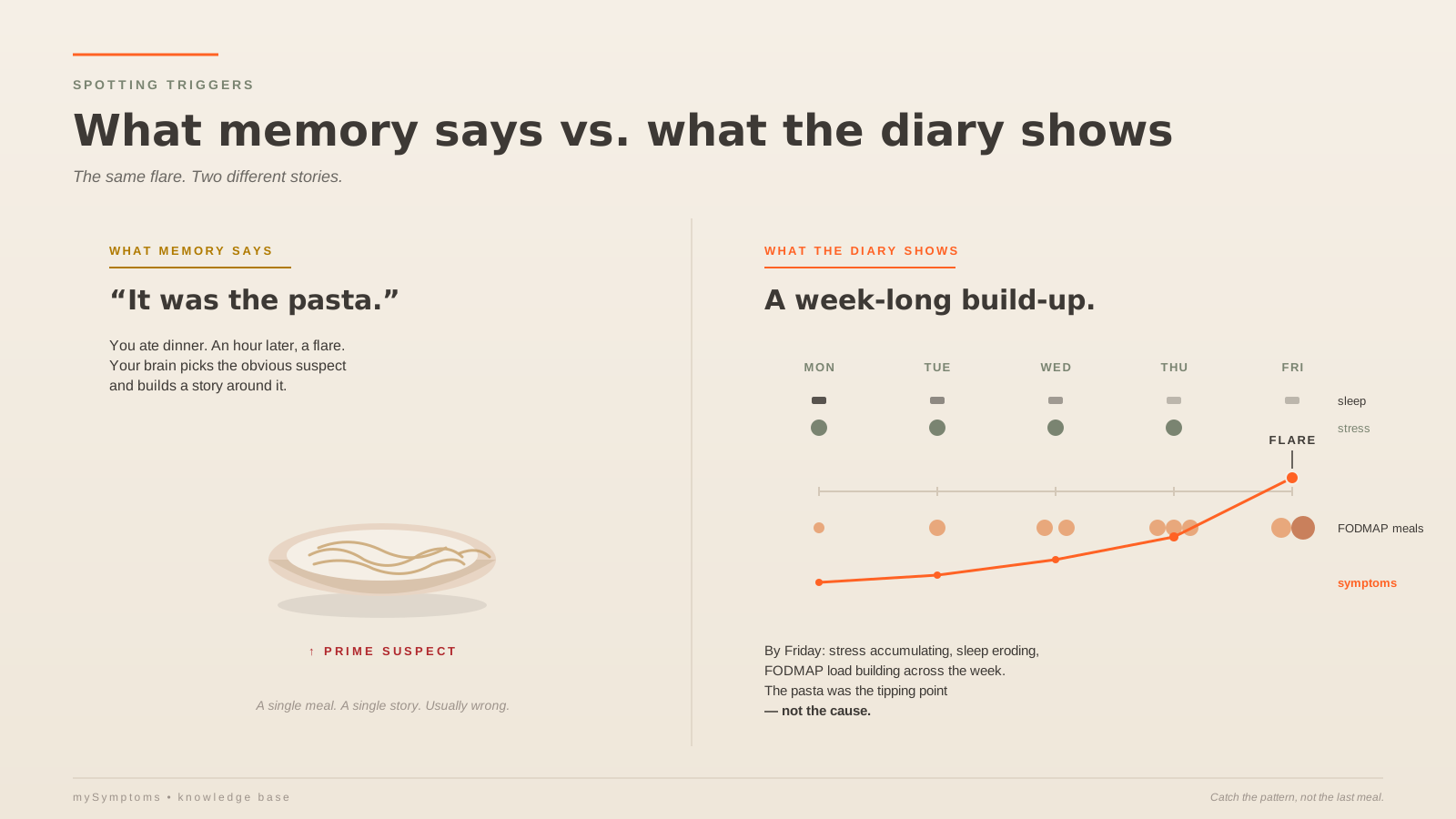
We all want the flare-up moment to make sense: I ate pasta. Thirty minutes later, pain. Aha — it must be the wheat.
But IBS doesn’t work like a food allergy. The 2021 ACG Clinical Guideline classifies IBS as a disorder of gut–brain interaction — a complex interplay between diet, stress, hormones, and the nervous system that controls digestion (Lacy et al., 2021). Here are three ways the “it was lunch” logic falls apart:
Cumulative load
Many IBS triggers appear to be dose-dependent. One serving might be fine; three across the day tips the balance. That’s why Tuesday’s breakfast may feel fine but by dinner you’re bloated without knowing why. The low-FODMAP literature in particular shows that cumulative FODMAP load matters as much as any single food (Monash University).
Delay and digestion
Symptoms don’t always appear right after eating. Reactions can take hours to develop, and for some people they show up the next day. That’s why blaming only the last meal before a flare often points to the wrong place.
Context matters
Caffeine, stress, lack of sleep or a menstrual phase shift can all change how your gut reacts to the same meal. The brain–gut axis means that emotional and physiological context interact with food in ways a meal-by-meal record can’t capture on its own (Lacy et al., 2021; Chey et al., 2022). Without context in your data, the true pattern hides in plain sight.
Patterns you can’t see without proof
Most people don’t realise how many false associations they build until they start tracking properly. You might “know” that caffeine causes flares, only to find the real pattern is late nights plus coffee plus skipping breakfast. The coffee itself was fairly innocent — just in amongst the wrong crowd.
A diary reveals these crucial overlaps. True, it’s not glamorous — but it’s objective. Over time, you’ll notice trends like:
- Symptoms ramp up a day or two after high-FODMAP dinners.
- Alcohol only causes trouble when paired with poor sleep.
- Beans are fine, but beans + stress + no water = total gut chaos.
So it stops being a guessing game and starts to look like data science (with a few more burps).
Why guessing backfires
We usually deal with uncertainty by cutting more and more foods. It feels productive. But this kind of “elimination roulette” has real downsides:
- Over-restriction: you lose nutrients, flexibility and social confidence in the name of control.
- Under-resolution: symptoms improve a little but plateau at 50% better because the real triggers remain.
- Increasing fear: every meal becomes a potential threat, which itself can affect how the gut responds, given the well-established two-way interaction between brain and gut in IBS (Lacy et al., 2021).
The case for a food + symptom diary
Tracking isn’t sexy. But it works.
Structured food and symptom diaries are commonly used in clinical practice for exactly this reason: they catch what memory misses — delayed reactions, cumulative effects, the role of context — and they give the user and their clinician something concrete to work from.
Think of tracking as a mini-experiment in real time:
- Note food, portion and timing. Don’t get hung up on grams and calories; the main thing is to be consistent.
- Look at symptoms in the hours and day after eating, not just the next 30 minutes. Reactions can be delayed, and a wider window catches more.
- Add context: sleep, stress, hormones, exercise, medication.
- Review weekly. Look for repetitions, not isolated coincidences.
Patterns don’t appear in single days. They show up in clusters over days and weeks, and that’s often where true insight can be found.
Tech that makes it easier
You don’t have to carry a notebook or spreadsheet your life away. Apps like mySymptoms make tracking easier — helping you log meals, symptoms, timing, stress and sleep quickly, with the analysis highlighting which individual foods most often appear alongside your symptoms.
The bigger patterns — cumulative effects, delayed reactions across multiple meals, the way stress or sleep changes how you respond — often need the wider review of the diary itself, which is where you (or you and a dietitian) read the bigger story.
Digital logs also give you something concrete to share with a dietitian or clinician. Instead of vague “I think onions bother me,” you bring a timeline that shows exactly when and how often symptoms hit. That gives them something to work with.
Research that backs it
- Dietary self-report is reliably imperfect. Validation studies against objective biomarkers show people under-report energy intake by around 30% on average (Freedman et al., 2014).
- Low-FODMAP works for many people, but the evidence comes from supervised protocols. Reviews of the trial evidence summarised in the 2022 AGA Clinical Practice Update on Diet in IBS report meaningful symptom improvement in a substantial proportion of patients on a properly supervised low-FODMAP protocol (Chey et al., 2022). DIY low-FODMAP without dietitian guidance produces much more variable results.
- Stress and gut symptoms interact. The well-established brain–gut axis means stress and emotional context can influence symptom intensity, which is why guidelines now classify IBS as a disorder of gut–brain interaction (Lacy et al., 2021).
- Structured tracking sits in modern IBS dietary guidance. The 2021 ACG Clinical Guideline includes dietary assessment as part of the recommended workup for IBS, and the 2022 AGA Clinical Practice Update discusses food and symptom diaries as a practical tool to support dietary intervention (Lacy et al., 2021; Chey et al., 2022).

Less flare. More freedom.
You might be thinking, not another thing to track. And I get it. But this isn’t about adding more admin to your day or obsessing over every symptom. It’s about giving yourself some answers.
When you start recording what you’re eating, how you’re feeling and what’s going on in your life, patterns begin to appear. Food stops feeling like the enemy and becomes useful information. You can reintroduce foods with more confidence, spot when stress (rather than bread — good news!) seems to be behind your symptoms, and stop second-guessing every meal.
If you’re tired of guessing, start keeping a simple record. Keep it realistic, keep it honest and stick with it for a few weeks.
Because the next time you think, I know what triggered that, you’ll have something more than a hunch to go on.
Want to start tracking?
If you’d like a diary built for this kind of tracking, mySymptoms lets you log food, symptoms, timing, stress, sleep and bowel habits in one place. The analysis surfaces the food-symptom correlations it can see in your entries, and the diary itself gives you and your clinician the context to read the bigger patterns. It won’t diagnose IBS or tell you what to cut from your diet, but it can give you something concrete to bring to a GP or dietitian.
References
- Chey WD, Hashash JG, Manning L, Chang L. AGA Clinical Practice Update on the Role of Diet in Irritable Bowel Syndrome Patients: Expert Review. Gastroenterology, 2022;162(6):1737–1745.
- Freedman LS, Commins JM, Moler JE, et al. Pooled results from 5 validation studies of dietary self-report instruments using recovery biomarkers for energy and protein intake. American Journal of Epidemiology, 2014;180(2):172–188.
- Lacy BE, Pimentel M, Brenner DM, et al. ACG Clinical Guideline: Management of Irritable Bowel Syndrome. American Journal of Gastroenterology, 2021;116(1):17–44.
- Monash University, Department of Gastroenterology. The Low FODMAP Diet. monashfodmap.com.
Important
mySymptoms is a food, symptom and lifestyle diary. It helps you record and review your own data — it does not diagnose, treat, cure or prevent any medical condition, and it is not a medical device. This article is general information, not medical advice. Always consult a qualified healthcare professional about your symptoms or before changing your diet.